Friday

Fun, Fun,Fun Summertime Blog Hop ~ Only 3 Days Away

I have teamed up with some wonderful teacher bloggers and we are going to have a blog hop that starts in 3 days. In the blog hop, you will read about ways to help keep your kiddos learning throughout the summer. We have even have some freebies to get you started! Make sure you follow my blog so that you don't miss out on this exciting event!
http://wyattswiseowlteachercreations.blogspot.com/

Monday

Coming Soon: Fun, Fun, Fun Summertime Blog Hop

I have teamed up with some wonderful teacher bloggers and we have  great news! Make sure you follow my blog so that you don't miss out on this exciting event!
http://wyattswiseowlteachercreations.blogspot.com/

Effective Reading Instruction in the Elementary School Setting : Week 2~ Phonological Awareness vs. Phonemic Awareness

   (Click on the picture above to read the first post in this series.)

Welcome to this week's discussion on Phonological Awareness vs. Phonemic Awareness. This week I will continue to share ideas to assist students in the mastery of  phonological awareness subsets word awareness and syllable awareness. 


Word Awareness

Word awareness is one area in phonological awareness. This skill requires students to be able to distinguish individual words from a sentence or phrase. Students that have word awareness will be able to explain the different words that are within a sentence. For example:
I am playing.  
Children with word awareness will be able to explain that this sentence has three words.
/I/  /am/ /playing/.

What Strategy will help with word awareness?
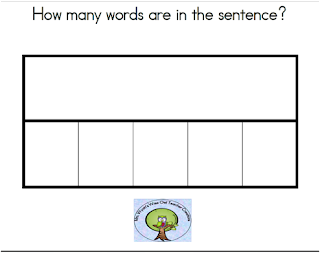
One strategy that you can use to introduce this concept is a "Word Count" graphic organizer.  To begin, model how to use the "Word Count" graphic organizer by saying a simple sentence with only two to three words. Then repeat the sentence using pauses in between words to ensure students can distinguish individual words. Also, place a counter on the  "Word Count" graphic organizer for each word.  (Be sure to cover the graphic organizer from left to right to model how students would read the sentence.)  Complete this process with several more sentences and give students opportunities to work with partners and individual practice.  Be sure to have students explain how they completed the graphic organizer to assess their understanding of the skill.
I have create a graphic organizer you can download and use to implement this method.


Syllable Awareness


Syllables awareness develops after students understand word awareness. Teachers can begin to teach syllable awareness using students names,compound words and eventually moving to words with two or more syllables. Listed below are wonderful resources that can be used to teach syllable awareness.


Websites with Great Syllable Awareness Activities 

Reading Rockets
http://www.readingrockets.org/article/phonemic-activities-preschool-or-elementary-classroom 

Florida Center for Reading Research
http://www.fcrr.org/Curriculum/pdf/GK-1/PA_Final_Part2.pdf 


Your Turn~

I hope you found this post full of information and strategies you can use in your classroom. Also, I would love to hear from you!  So let's have a share session. :) 
Please respond to the following questions.

1. What did you find the most useful in this week's post? 

2. What activities and strategies do you use in your classroom to teach these skills?

I am so looking forward to hearing from you!

Next Week ~Phonemic Awareness

References 
http://www.fcrr.org/Curriculum/pdf/GK-1/PA_Final_Part2.pdf
http://www.readingfirst.virginia.edu/prof_dev/phonemic_awareness/words_syllables.html
http://www.readingrockets.org/article/phonemic-activities-preschool-or-elementary-classroom 


Saturday

Reading Response Booklets Giveaway

I am so honored and humbled by all of your support with my teacher shops on Teachers Notebook and Teachers Pay Teachers. To say "Thank You" I am having a giveaway. Please leave your name and email address in the comments section and complete the instructions from the Rafflecopter icon below. I will notify the winner of my Reading Response Booklets by email on August 1, 2015. (Also, I will add you to my new newsletter list.) Please feel free to share this information about the Giveaway with your friends.
Reading Response Booklets Giveaway ends July 31, 2015


a Rafflecopter giveaway

Wednesday

Effective Reading Instruction in the Elementary School Setting : Phonological Awareness vs. Phonemic Awareness


Hello Everyone,
Welcome to my first post in a series on "Effective Reading Instruction in the Elementary School Setting." This series will take place over the next few months and each month will have a different  literacy focus. I would love for this to be an interactive "forum" and want to hear from you. So please share you thoughts and anything you have found helpful in your classroom.
So, let's begin!
 

 Phonological Awareness vs. Phonemic Awareness

Did you know that students that struggle with the mastery of phonological awareness could also struggle with reading and writing skills? Wow, that scary! In this post, I hope to share some effect strategies and activities that will assist with the instruction of these skills.
 
So What's the Difference?

Both phonological awareness and phonemic awareness deal with the sound elements in  oral language, however they are not the same concept. According to Barbara Fox's book, Word Identification Strategies Building Phonics into a Classroom Reading Program, "Phonological Awareness is the awareness of the words, syllables, rhymes, and sounds in language, and the ability to blend individual sounds in words. (Fox, 2008) Phonological awareness encompasses word, rhyme, syllable, and phonemic awareness. Yes, phonemic awareness is a part of phonological awareness. Phonemic awareness consists of the individual phonemes or sounds in words.  This simply means students must learn how to isolate, segment, blend, and manipulate sounds orally in spoken language. (Fox, 2008)

Strategies and Activities to Foster Phonological Awareness: Rhyme


  • Rhyming Generation Strategy Freebie --

  •   Freeman's Frolicking Froggings has a great product for Rhyme

Rhyming Book-- FREEBIE!  


I will be discussing and sharing more ideas next week. Until then, what are some ideas you use in your classroom? I can't wait to hear from!


Click on the link to read:
Effective Reading Instruction in the Elementary School Setting : Week 2~ Phonological Awareness vs. Phonemic Awareness

http://wyattswiseowlteachercreations.blogspot.com/2015/07/effective-reading-instruction-in_11.html
( Link will go live 7/13/15) 

References


Fox, B. (2008). Phonemic Awareness: Becoming Aware of the Sounds of Language. In Word Identification Strategies Building Phonics into a Classroom Reading Program (4th ed., pp. 26-29). Upper Saddle River, New Jersey: Pearson Prentice Hall.  
  
http://www.readingfirst.virginia.edu/pdfs/Phon_Spel_Handout.pdf

http://www.readingrockets.org/


Friday

Book Club: Unit 4 Reading Nonfiction, Reading the World


(Click on the picture above to visit The Sunny Side of Second Grade with Mrs.Felts to read about Unit 1.)


Hi Everyone,
Have you ever noticed that nonfiction texts seem to be harder for students to comprehend than fiction? Well, this week I will be talking about "Unit Four: Reading Nonfiction, Reading the World" from Lucy Calkins'  A Curricular Plan for The Reading Workshop: Grade 2. Calkins gives excellent strategies for teachers that will help our little kiddos have a better handle on information text. Below are just a few of my favorite strategies from Unit Four.

Suggested Ways to Approach Nonfiction Texts


Setting Up the Nonfiction Library: Allowing Readers to Sift and Sort
  • Calkins begins this section by suggesting that teachers create an anticipatory set for the introduction of nonfiction. This is done by having texts that are related to science and social studies content. Then continue to explain to students that good readers read nonfiction to get "smarter." This is such a great "hook!" What a brilliant way to make students feel comfortable and successful because they already have background knowledge in these areas. 
Part One: Nonfiction Readers Read to Become Smarter about Our World and the Things in It
  • In this section of the unit, I love how Calkins points out that students need to understand text features and how text features assist  readers in understanding a given text. However, this is not an area where teachers and students should take long periods of instructional time on identifying text features and never actually read the passage. This is a very valid point. I want my students to understand the importance of text features, but actually reading and understanding how the text features help them comprehend is much more valuable.
Part Two: Nonfiction Readers See More Than the Text on the Page
  • My favorite part of this section is how good readers do more than just read the words from a nonfiction passage. Good Readers actively read the selection by thinking, asking, and responding to questions they have about the selection. Making connections to texts deepens students comprehension skills.Calkins' goes on to suggest that readers record their thoughts , questions, and responses to text by writing them on post it notes or a mini-pad and sharing/discussing with a partner. I love this idea! When students can write about a concept they understand and can apply it. Below are some posters I made that reminds students the different ways a reader can make connections to text. Click on the picture to download a copy for your classroom.

Part Three: Nonfiction Readers Tackle Tricky Words in Our Books
  • I agree with the author that word study is a very important part of reading. When students begin to read nonfiction they will encounter many unfamiliar words. It is imperative that I model during shared reading on how to "tackle" these unfamiliar words. Students need to be able to apply the word study skills in their own reading experiences. 
Part Four: Nonfiction Readers Can Read More Than One Book about a Topic to Compare and Contrast
  •  This last section is about how students work in collaborative groups to study a subject using several texts and then comparing and contrasting the material. I agree that "book clubs" are a great way for students to research or learn more about a topic by collaboratively selecting  books. The best part is that students, without realizing it, discover the real purpose for reading nonfiction. Also, students are developing their higher order thinking skills by comparing and contrasting information. This allows students to take information from several books and combine the ideas for a given subject. This is such a "Win - Win Situation!" Below are two interactive notebook templates I created for students to use while reading: Compare and Contrast Information and Question, Response, Discuss. Click on the pictures to download these freebies.


"Unit Four" gave me a great action plan that will assist me in fostering my students' reading abilities this coming school year. I hope you found my review of  this section useful and I can't wait until we read the next section!

Be sure to tune on July 6 as Nicole from Sprouting in Second Grade will be discussing Unit 5.